
Is Coliving Worth It? An Honest Cost-Benefit Analysis
For most digital nomads who've tried it, the answer is yes, and not even close. Coliving typically runs €800 to €1,800/month all-inclusive: accommodation, utilities, fast WiFi, coworking space, and community built right in. Compare that to a furnished Airbnb (€700 to €1,200/month), add coworking (€100 to €300), utilities and WiFi (€80 to €150), and you've spent the same money, alone. The financial case is roughly a wash. The ROI is everything else: you move into a place with 15 people who already know your name, skip three months of awkward networking, eat better, work more productively, and leave with actual friendships. The people who don't get value from coliving are those doing it for the wrong reasons: treating it like a cheap hotel, avoiding community, or expecting a 5-star resort at hostel prices. If you're a remote worker who's ever felt isolated in a new city, coliving is almost certainly worth it.
We've run 6 chapters of coliving across Brazil, Spain, Portugal, and Mexico with 180+ guests. Some arrived skeptical. Almost all came back. So yeah, we have opinions on this.
Let's actually do the math, and be honest about when coliving isn't worth it too.
What Does Coliving Actually Cost?
There's a huge range. A basic coliving in a cheaper destination (Southeast Asia, Eastern Europe, Latin America) might run you €500 to €900/month. A premium pop-up coliving in Europe or a curated experience with included meals could reach €1,200 to €2,200/month.
For reference, here's roughly what you'd pay at Casa Basilico:
That covers accommodation, fast WiFi, a community coworking space, and regular communal events. Some chapters include daily meals. Some don't. Check our current chapter pricing.
Now for the actual comparison.
What Are You Really Comparing Coliving To?
This is where people mess up the math. They compare coliving to a cheap hostel dorm or a basic Airbnb studio and go "wow, coliving is expensive." But that's the wrong comparison.
The honest comparison is coliving vs. the full cost of being a digital nomad solo. Here's what that looks like:
Option A: DIY nomad in Oaxaca
Option B: Casa Basilico Oaxaca
You're not paying a premium for coliving. You're paying a different distribution of the same money, except you get a built-in community and someone else handles all the admin.
For some people the DIY setup works out cheaper, especially if you already have a long-term apartment contract, a free coworking desk, and a friend group in the city. But for someone arriving somewhere new for 1 to 3 months? The math usually breaks even or tips in favor of coliving before you even account for the social side.
What Are the Benefits of Coliving?
Beyond the spreadsheet, here's what people tell us after a month with us:
You skip the isolation phase entirely
Moving somewhere new solo is exciting for about a week. Then it gets lonely. Buffer's State of Remote Work consistently finds loneliness is one of the top challenges for remote workers: 21% cite it as their biggest struggle (Buffer, 2023). Coliving drops you into an existing social group from day one. You don't need to download Meetup, drag yourself to awkward nomad networking events, or build a friendship with someone over two weeks of uncomfortable nods at a shared coworking table. You already live with people who actually like you.
You work better than you expect
There's something about being surrounded by other people with laptops open that snaps you into focus. Gensler's 2015 U.S. Workplace Survey found that people in collaborative work environments report higher job satisfaction and productivity than those working in isolation.
The peer pressure is also real. When the person next to you is on their fourth Zoom call and it's 10am, you're probably going to stop scrolling and open Slack. Nothing against pyjama mornings. We love a pyjama morning. But some of us need ambient accountability to produce work.
You eat way better
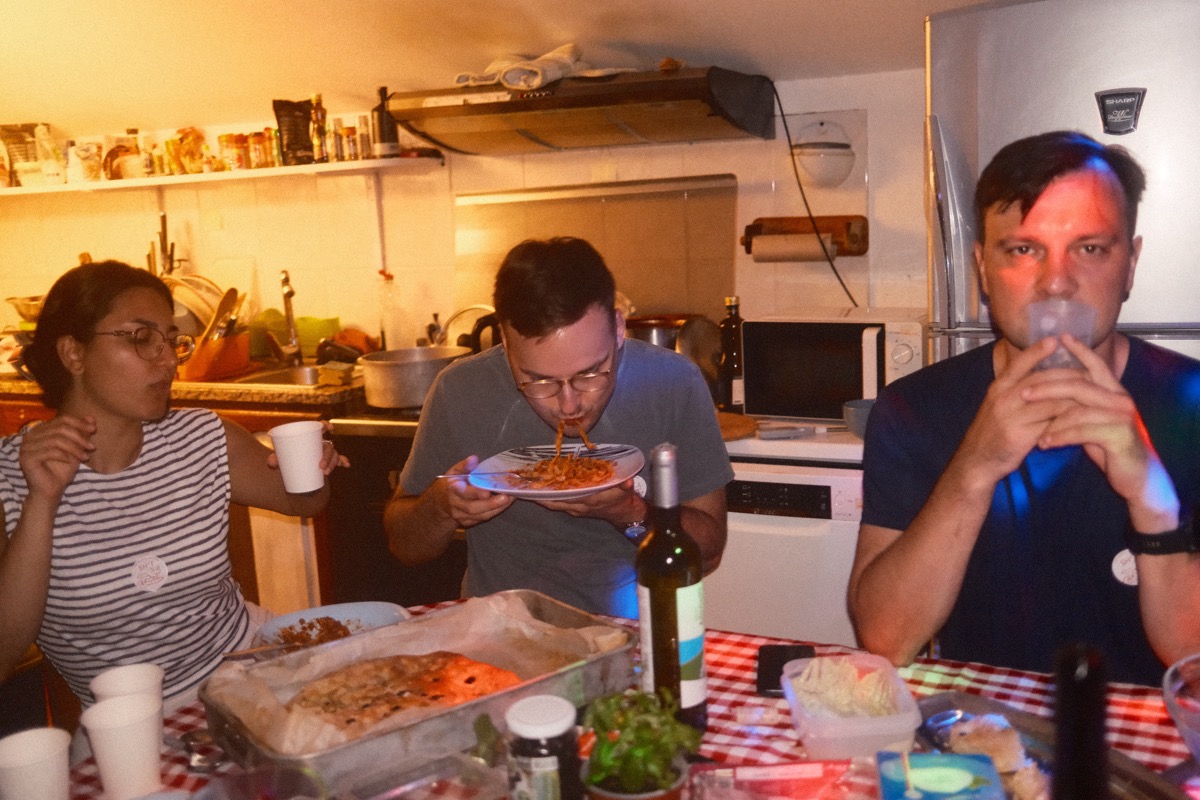
Okay, this one might be personal to Casa Basilico, but communal dinners and shared cooking genuinely improve the quality of your month. You're not eating sad pasta alone at 9pm. You're eating good pasta with 12 people at a real table, with someone who actually knows what they're doing in the kitchen.
Research published in the journal Appetite found that people who eat with others more frequently report higher subjective wellbeing. Turns out the Italians were right about meals being a social event. They usually are.
The network effect is criminally underrated
Every coliving house is a concentrated gathering of high-achieving, ambitious, interesting remote workers from across the world. In one month at Casa Basilico, you'll talk to designers, developers, marketers, entrepreneurs, coaches, lawyers, and writers, all in the kitchen making coffee at the same time.
We've seen people:
That network doesn't happen when you're alone in an Airbnb studio watching Netflix.
Zero admin, zero stress
No lease hunting in a foreign language. No WiFi setup roulette. No deposit drama. No "does this apartment have a desk?" No buying a frying pan in every new city. You show up with your suitcase and your laptop and everything just works. The mental load reduction alone is worth something, and if you've spent three days in a new city trying to sort your living situation, you know exactly what we mean.
Who Is Coliving NOT Worth It For?
We'd rather tell you coliving isn't for you than have you book, show up, and be miserable.
You'll probably hate it if:
Coliving works best for people who are open, adaptable, and in a reasonably good headspace. It amplifies whatever you bring to it. Bring enthusiasm and curiosity, you'll have one of the best months of your life. Bring misery and a closed door, it's going to be a long, expensive month.
The Lonely Airbnb Problem
Remote work is incredible. But there's a version of the digital nomad lifestyle that goes like this: fly to new city, get Airbnb, work 10 hours, eat alone, sleep, repeat. Do it in five cities in a year. Sound familiar?
Technically you were in Thailand and Colombia and Portugal. But did you actually experience those places? Or did you just work from different backgrounds on Zoom calls?
The freedom-without-community paradox is real. You can work from anywhere, which sounds amazing, but if you're doing it alone every time, "anywhere" starts to feel a lot like nowhere.
Pop-up coliving specifically exists to solve this. You get a ready-made community, a defined window of time, and a built-in reason to actually explore a place, because you've got 15 people asking "are you coming to the market this morning?"
After 6 chapters and 180+ guests, we can tell you: the people who say coliving changed their nomad life are almost always the ones who were doing the lonely Airbnb thing before. The switch is usually jarring in the best way.
How Do You Know If a Coliving Is Actually Good?
Not all colivings are equal. You can pay €1,500/month for what is functionally a social apartment building with a WeWork desk in the lobby. That is technically "coliving." It's also not what we're talking about.
Here's what separates the real ones from the rebranded student housing:
Red flags:
Green flags:
For what it's worth, we stress-test WiFi at peak hours before committing to any venue. We learned that lesson the hard way once. We won't say which chapter. The food was incredible. The internet was terrible. Never again.
Is Coliving Worth It? Here's Our Verdict
For most remote workers, yes. The community, the network, the mental health benefits, and the lifestyle upgrade make it worth the cost. When you do the real math, it usually isn't much more than going it alone.
The key is finding a coliving that's actually built around community and not just rebranded accommodation with a logo slapped on it. Do that, and you'll have a month that justifies every euro you spent.
We've been running pop-up coliving chapters since 2024 and the same guests keep coming back. That's probably the most honest endorsement we can give. Nobody returns to something that wasn't worth it.
Come see what the fuss is about. 🍝
Yes, I want to try coliving with Casa Basilico
FAQ: Is Coliving Worth It?
Is coliving cheaper than renting an apartment?
Depends on the city and the length of stay. For stays under 3 months in popular nomad destinations, coliving usually breaks even or wins once you factor in coworking, utilities, and the actual cost of your social life. For stays over 6 months, a long-term lease is almost always cheaper on a pure cost basis. But cost isn't the only metric. A month of genuine community is worth something that doesn't show up in a spreadsheet.
Is coliving worth it if you're introverted?
Yes, if it's the right coliving. Introverts often love coliving precisely because it provides low-effort social connection: you don't have to "go out" to be around people. You can retreat to your room when you need to recharge. The key is finding a coliving with a good balance of communal and private space, and a host who doesn't guilt-trip you into socializing at every opportunity.
How long should you stay in a coliving?
Minimum one month. The first week is adjustment. The second week you find your people. The third week you're fully integrated. The fourth week you don't want to leave. Shorter stays are possible but you miss the depth that makes it worthwhile. That's why we have a 1-month minimum at Casa Basilico: anything shorter and you're basically just a tourist who happens to share a kitchen with strangers.
What's the difference between a hostel and a coliving?
Hostels are optimized for short stays, cost-cutting, and high turnover. Colivings are optimized for remote work, community, and month-long stays. Practically: colivings have dedicated desks, reliable fast WiFi, private rooms (usually), and intentional programming. Hostels have shared dorms and a bar downstairs. Both are valid: they're solving very different problems. More on what coliving actually means.
Is coliving worth it for couples?
Yes, with caveats. You need to be comfortable sharing common spaces and social time with a group of near-strangers. Some couples love it: you get the adventure and the community together. Others find the reduced privacy stressful. Most good colivings have private ensuite rooms, which helps a lot. We've had plenty of couples at Casa Basilico who had a genuinely incredible time. And some who confirmed they needed their own apartment to survive each other. Both outcomes are valid and we respect both.


Spreading love through cooking & community.
© 2026 CasaBasilico OÜ (16850261)
All rights reserved.
Design & Branding by ahgoos.com
info@casabasilico.com