
Coliving for Couples: What to Know Before You Go
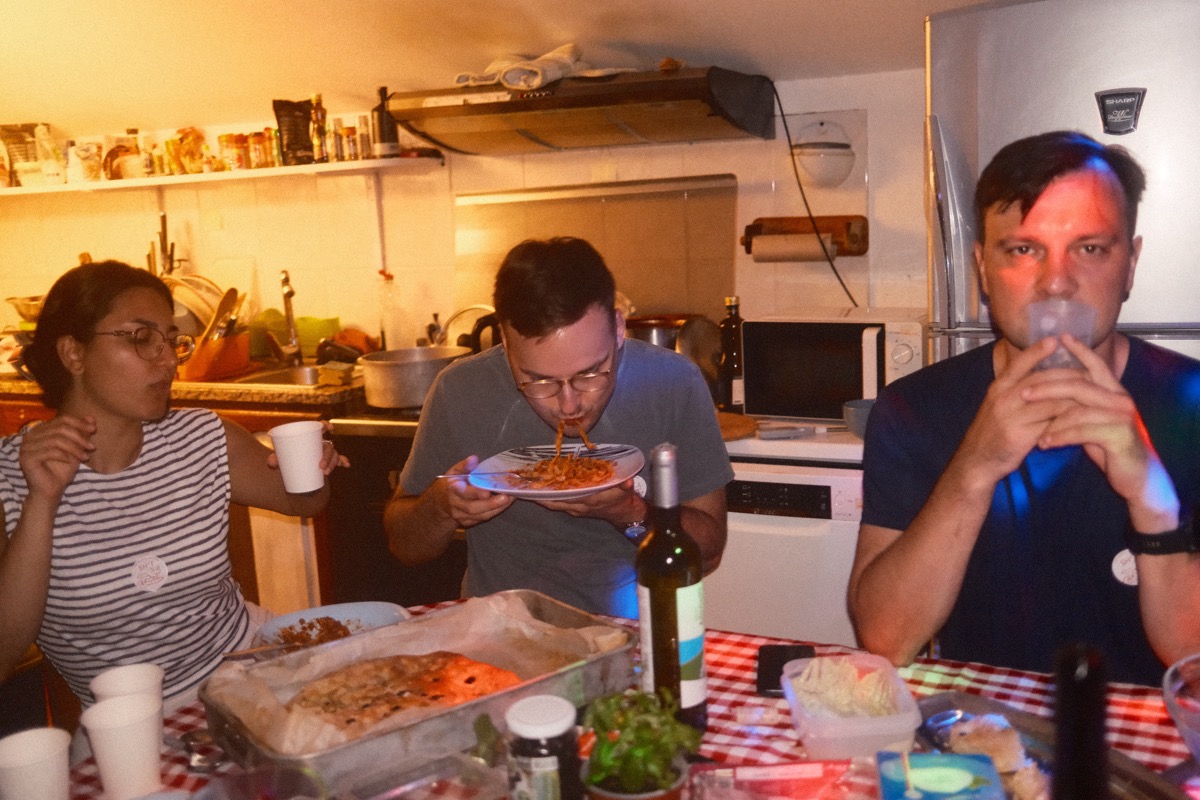
Coliving works well for couples who are intentional about it. The main things to know: you'll share common spaces with other guests (usually 8 to 16 people), your private room is yours, and the social pressure is real but never mandatory. Couples who thrive tend to be the ones who don't arrive joined at the hip. They show up, make friends independently, and reconnect over dinner. The ones who struggle are usually trying to use coliving as a substitute for a private holiday. Research shows couples who maintain separate social lives alongside shared ones report higher relationship satisfaction (Journal of Social and Personal Relationships, 2019). At Casa Basilico, we've hosted couples who became the social glue of the whole chapter, leading cooking nights, organizing hikes, rallying everyone to the mercado. And a few quiet couples who kept to themselves and still had a great time. Both are valid. The community is real, the WiFi is fast, and nobody will make you do a trust fall.
One question we get a lot: "We're a couple. Is this actually for us, or would we be the boring ones who go to bed early while everyone's still at the table?"
Honest answer: coliving is absolutely for couples. But it's not for every couple. The difference has less to do with the coliving itself and more to do with how you two operate as a unit.
We've hosted couples across five chapters in four countries. We've seen them arrive as a pair and leave with an entirely new crew of friends they're already planning to visit. We've also seen couples who arrived expecting a romantic retreat and spent two weeks mildly puzzled by the pasta-fueled chaos around them. Both stories taught us a lot.
No fluff, no "coliving is for everyone" marketing speak. Just the actual guide.
What's the actual setup: do we get our own room?
Yes. You get a private room together. That's the deal.
At Casa Basilico, every couple books a private room, usually a double bed, sometimes a king depending on the property, always with a lock on the door. The shared parts are the kitchen, living areas, dining space, and the coworking setup. You share those with 8 to 16 other guests depending on the chapter.
Think of it like renting a room in a really well-curated house with interesting strangers who all have laptops and strong opinions about how pasta should be cooked. Not a hostel. Not a hotel. Something weirder and better.
The rhythm of a typical day: everyone comes and goes as they please. Breakfast is usually independent (someone inevitably makes too much coffee and offers it around). Work happens in the shared space or nearby cafes. Evenings are the best part: communal dinners, cooking nights, spontaneous plans that somehow turn into the highlight of the entire month. You participate as much or as little as you want.
Will we actually have privacy?
More than you'd expect, less than a private Airbnb.
Your room is your sanctuary. Nobody knocks unless invited. But the shared spaces are, by definition, shared. If you need two hours alone in the kitchen having a long serious conversation, you'll probably have company at some point.
The couples who navigate this best tend to acknowledge it in advance. Not overthink it, just know that living with other people changes the energy around you. You're less likely to have a drawn-out argument about whose turn it is to book flights. You're more likely to get interrupted by something funny happening at the dinner table that makes both of you forget what you were stressed about.
Buffer's 2023 State of Remote Work report found that 23% of remote workers say loneliness is their top struggle. Couples don't usually have the loneliness problem. But they often have the opposite one: being too inside their own world. Coliving is good medicine for that, without forcing anything.
What if one of us is way more social than the other?
This one comes up a lot.
One person gravitates toward every group dinner and spontaneous market trip. The other recharges alone and needs an hour of quiet after a long workday. In a regular apartment, this tension exists anyway. In coliving, it just gets more visible because there's always something happening to opt into or out of.
What works: treating the communal stuff as individually optional. At Casa Basilico, nobody's required to show up to anything. There are no mandatory bonding activities, no scheduled team-building, no enforced fun. Come to the cooking night on Tuesday if you want. Order something and decompress in your room if you don't. Both are fine.
The couples who run into trouble here are the ones who make an agreement like "we'll only go if we both go." That arrangement tends to make the extrovert resentful and the introvert guilty. Better to negotiate it differently: "you go, tell me everything at breakfast."
What about working together all day, then living together all evening?
If you're both remote workers, this is the question that matters most.
There's a pattern that couples working from home together recognize quickly: the lines between work mode and off mode collapse. Suddenly you're always on, always accessible, always slightly in each other's business. Research in relationship psychology shows that proximity without natural separation increases friction even between people who like each other.
Coliving helps with this, somewhat counterintuitively. Because there are other people around, you spend parts of the day in different configurations. One of you works from the communal table. The other takes a coworking cafe nearby. You're not surgically attached from 9am to 9pm.
The communal dinner is a natural circuit breaker. You're not just talking about work or logistics because there are eight other people at the table talking about their day too.
why coliving beats hotels and hostels for remote workers
What do couples actually say after doing it?
We've asked. Most couples who've done a full chapter with us say the same thing: it was better than a holiday. You're not getting candlelit dinners for two. You're getting long loud dinners for twelve with someone at the table telling a story that's going slightly too long and everyone leaning in anyway.
The couples who arrive expecting "romantic retreat energy" leave a little flat. The couples who arrive expecting "interesting adventure with my person" leave already talking about the next one.
A few things couples report:
what we've learned from hosting 200+ nomads
What makes or breaks it for couples?
Coliving tends to work for couples when:
It tends to get hard when:
Full disclosure: we, the two people running Casa Basilico, are not a couple. We're best friends and business partners who get asked if we're together approximately four times per week. So we have a front-row seat to what actual couples look like in this environment, without being inside it ourselves.
our current chapter in Oaxaca, Mexico
FAQ
Is coliving good for couples who are both working remotely?
Yes, often more than it is for solo nomads. Having a partner already solves the loneliness problem, and coliving adds the social variety and energy that makes the experience interesting without requiring you to be "on" all the time.
Do couples pay more than solo travelers?
At Casa Basilico, couples book a private room together. The room price is per room, not per person, so you're effectively splitting one accommodation between two people. It's usually better value than two solo travelers booking separate rooms.
What if we want couple time and community time?
That's the normal mode. Nobody's going to make you eat every meal with the group. You can disappear for a weekend, nobody takes it personally. The flexibility is real and it's the point.
Is coliving a good idea if we're going through a rough patch?
Mixed results, honestly. A change of scenery and a new community can take the pressure off and give you both something to be interested in together. But if you're hoping to sort through deep relationship stuff in a shared house with twelve other people, that's probably not the right setting. Come because you're excited about the experience, not as a fix.
How do couples typically fit into the community?
Better than you'd think. Couples often become anchor points: reliable, social, the ones who invite people in. Some of our most memorable chapters have been shaped by the couples who decided to just show up and host everyone. Come to dinner. Offer to cook once. The rest tends to follow.
If you're a couple considering a chapter and you've made it this far, you're probably the right kind of people for this. The ones who think it through, feel a little unsure, and then do it anyway.
Current chapter: Oaxaca, Mexico. Private rooms available, communal kitchen is excellent, and yes, tacos happen weekly. ❤️


Spreading love through cooking & community.
© 2026 CasaBasilico OÜ (16850261)
All rights reserved.
Design & Branding by ahgoos.com
info@casabasilico.com